


Driving Safely on Georgia’s Icy Roadways
A truck driver was injured when his vehicle skidded and overturned in Gilmer County. According to a WSB-TV news report, the truck accident occurred on Old Highway 5 just outside of downtown Ellijay. Officials say the truck, which was transporting more than 1,000 chickens to a processing plant, skidded on an ice-covered bridge. The bridge was frozen over and the vehicle overturned. The driver suffered minor injuries.
The cold, icy conditions have made traveling in Georgia treacherous this winter. It is absolutely vital that all motorists exercise due care when traveling in these icy conditions. Before getting on the road, it is advisable to check your tires. You want to have properly inflated tires that have adequate tread to grip the road.Read more…
Children Killed in Georgia Tractor Trailer Accident
Two boys, aged 6 and 12, were killed in a Georgia car accident involving a collision between a tractor-trailer and an SUV. According to a news report in The Dalton Daily Citizen, the fatal truck accident occurred on Old U.S. 411 and Georgia 136 in Murray the morning of January 4, 2013. Officials say a GMC Envoy may have failed to stop at a stop sign before colliding with the tractor-trailer. The two children were pronounced dead at the scene of the crash. Their 39-year-old mother and 13-year-old relative were hospitalized. The 41-year-old truck driver was also taken to a nearby facility for treatment.
Many Georgia traffic accidents occur at intersections. It is crucial for everyone’s safety for motorists to obey all traffic control devices. According to Georgia Statute 40-6-72: “Every driver of a vehicle approaching a stop sign shall stop…After stopping, the driver shall yield the right of way to any vehicle in the intersection or approaching on another roadway so closely as to constitute an immediate hazard during the time when such driver is moving across or within the intersection or junction of roadways.”Read more…
FMCSA Pushes to Overhaul Computer Systems, Stop “Chameleon Carriers”
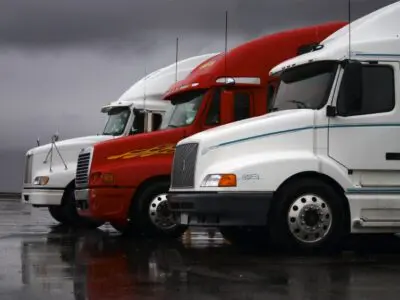
The Federal Motor Carrier Safety Administration (FMCSA) is responsible for keeping track of safety violations and other legal violations made by commercial truck and bus companies within the U.S. If a company’s violations are particularly dangerous, repetitive, or common, the FMCSA has the power to put the company “out of service,” forcing it to stay off the roads until the issues are corrected.
In recent months, however, the FMCSA has found that its outdated computer systems – which are maintained separately and do not share information with one another – are making it increasingly difficult for the agency to keep up with “chameleon carriers.”Read more…
Trucking Association Seeks Review of New FMCSA Rules

The American Trucking Association (ATA) recently asked a federal court to review the new hours of service (HOS) rules passed recently by the U.S. Federal Motor Carrier Safety Administration (FMCSA).
The new rules restrict the total number of hours drivers can work. Previously, drivers were allowed to drive 11 hours per day and to be on duty for a total of 14 hours. They could not drive more than 80 hours in 7 days, and were expected to rest for at least 34 hours before starting a new “countdown.”Read more…
Avoid Runaway Truck Accidents in Georgia
Commercial trucks go by multiple names: big rigs, tractor trailers, semis, or 18 wheelers. They exist in a special class of vehicles, which weigh up to 80,000 pounds and that are the largest and heaviest on the highways. They are required to operate under strict safety standards set forth by the state and federal government. Any miscalculation or neglect in the operation of large commercial vehicles leaves other motor vehicle drivers extremely vulnerable, and can result in tragic large truck accidents.
A crash is typically classified as a runaway truck accident for a number of factors, all of which usually include problems with speeding. This type of accident happens if the velocity of the trailer in tow does not equal the velocity of the truck. This often results in a loss of steering control, greatly increasing the chance of accidents. And in some instances, the back trailer may come loose from the truck to careen treacherously along the highway, creating deadly threats to surrounding motorists.Read more…
New Rules for Big Rig Drivers on the Horizon?
The U.S. Department of Transportation (DOT) is debating a revision to what’s called the “hours of service rules” for commercial vehicle operators. The rules mandate the frequency and length that any commercial driver can stay on the job during any given shift. The potential shift may decrease the allowed hours from eleven to ten in each 24 hour period, according to reporting by the Worcester Times. The revision may also demand additional mandatory rest periods between the hours of 12:00 am and 6:00 am, a time window relished by truckers for its light traffic, but feared by other vehicle drivers for its propensity to induce deadly levels of driver fatigue.
Big rigs (also known as 18 wheelers, semis, or tractor trailers) are among the most dangerous vehicles on the road due to their immense and imposing size and weight. The slightest miscalculation, lapse in judgment, or negligent action by a driver can result in catastrophic accidents.Read more…
DOT Considering All-Cell-Phone Ban for Commercial Truck Drivers
Distracted driving has become a growing concern for all drivers nationwide. However serious distracted driving or cell phone accidents may be with common passenger cars, they are substantially more severe when the accident involves a commercial vehicle. The devastating results of recent commercial vehicle accidents involving cell phones have prompted the proposal of a federal ban on all cell phone use for commercial vehicle drivers, according to The New York Times.
Bus drivers were banned from cell phone use after a crash in 2004 and, very recently, all commercial operators of marine transportation and railroad transportation were banned after a 2010 barge and tourist vessel crash in Philadelphia and a 2008 train crash in California.Read more…
What are the Legal Size and Weight Limits for Tractor-Trailers in Georgia?
According to the Insurance Institute for Highway Safety (IIHS), a large truck weighs more than 10,000 pounds and may either be a single-unit vehicle or a combination vehicle of a single-unit pulling one or more trailers. Although any truck weighing more than 10,000 pounds may be categorized as a large truck, most large trucks on the road tend to weigh much more than that. A large truck’s size and weight limitations are governed by both federal and state laws as there are both interstate and intrastate highway systems in Georgia.
The Federal Highway Administration (FHWA) limits commercial trucks to a gross vehicle weight of 80,000 pounds on the interstate highway system. However, the gross vehicle weight is not the only limit. The weight distribution over the axles and wheels are also specified to prevent overloading and improper loading, which can cause the truck and trailer to rollover. Additional interstate size restrictions include a width of 102 inches and a maximum length of 780 inches (65 feet) or 900 inches (75 feet) as determined by the trailer connection. Although there is no federally imposed height restriction, most large trucks follow the 13.6 or 14.6 foot standard.Read more…
What Georgians Should Know about Jackknife Accidents
Any accident involving a big rig increases risk of serious injury, but jackknife accidents have the potential to cause a larger accident area. When a tractor trailer or other articulated vehicle jackknifes, the cab and the trailer fold at their pivoting or linking joint until the vehicle forms an acute angle, like a folding knife, with the cab and trailer facing opposite directions. In a jackknifed position, the big rig would become stuck, usually across multiple lanes of traffic, which can cause chain reaction accidents.
According to the Federal Motor Carrier Safety Administration (FMCSA) 2009 Large Truck and Bus Crash Facts, there were 295,215 large truck accidents in that year. Over 4,000 of these were jackknife accidents. The 4,146 jackknife accidents included 3,000 property damage crashes, 1,000 injury crashes, and 146 fatal crashes.Read more…
Overloaded Trucks Jeopardize Safety of Georgians
Georgia large truck accidents can be devastating, but even more so when a truck’s weight exceeds legal limits. Overloaded and overweight tractor trailers are a danger to all other motorists on the road. When a truck is burdened with more weight than it can safely carry, common actions, such as turning, changing lanes, and braking, can be adversely affected. Furthermore, increased weight increases the force of any accident, making an overloaded truck accident especially destructive. Overloading a semi-truck, big rig, tractor-trailer, or 18-wheeler is common practice for trucking companies attempting to make extra profit, though it is both dangerous and illegal.
To prevent overloading, the Federal Highway Administration’s (FHWA) Freight Management and Operations department has established weight limits that apply to all commercial vehicles traveling on the Interstate Highway System. Intrastate trucks may have other weight restrictions as those are determined by the state, though most state trucking regulations coincide with federal ones. The legal weight limit of a commercial truck is 80,000 pounds, with a maximum of 20,000 pounds on a single axle. The distribution of weight, on axles and wheels, is just as important as the total weight of the truck.Read more…
Contact us today for a free and comprehensive case evaluation.
We require no legal retainer or upfront fees,
and you pay nothing unless we prevail.
Phone: (404) 995-3955

Categories
- ATV Accident
- Auto Accidents
- Bicycle Accident
- Birth Injury
- Burn Injury
- Bus Accident
- Child Injury
- Construction Accidents
- Distracted Driving Accidents
- Firm News
- Hit-and-Run Accident
- Holiday Events
- Insurance Bad Faith
- Legal Updates
- Medical Malpractice
- Mesothelioma
- Motorcycle Accidents
- Nursing Home Abuse
- Pedestrian Accidents
- Personal Injury
- Premises Liability
- Product Liability
- Spinal Cord Injury
- Traumatic Brain Injury
- Truck Accidents
- Wayne Grant Education
- Workplace Injury
- Wrongful Death


