


How Poor Inspection Procedures Cause Semi-Truck Cargo Spills in Atlanta
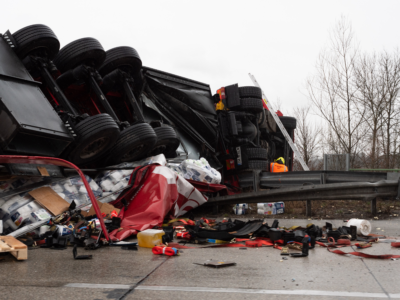
Semi-truck cargo spills are often the result of skipped safety steps, rushed drivers, and companies that prioritize fast delivery over public safety. When required inspection procedures are ignored, the consequences can be devastating.
Wayne and Kimberly Grant are a husband-and-wife truck accident law team in Atlanta. At Grant Law Office, we have seen how truck driver negligence and trucking company negligence contribute to semi-truck cargo spills.
Why Inspection Procedures Matter Under Federal Law
The trucking industry is governed by strict safety rules, including the Federal Motor Carrier Safety Regulations (FMCSRs). These regulations require drivers and trucking companies to follow detailed inspection protocols before, during, and after each trip.
These rules exist to prevent:
- Improper loading
- Unsecured cargo
- Equipment failures
- Overweight or unbalanced loads
Drivers must complete pre-trip inspections to confirm that cargo is properly secured. They must also re-check loads periodically during long hauls. Meanwhile, trucking companies are responsible for training drivers, enforcing compliance, and ensuring vehicles are safe for operation.
How Driver Negligence Leads to Cargo Spills
Driver behavior plays a major role in cargo-related truck accidents. Driver Negligence may begin before the truck ever leaves its starting point.
Skipping Pre-Trip Inspections
Drivers are required to inspect:
- Cargo securement devices (chains, straps, tarps)
- Load distribution
- Trailer integrity
When a driver skips or rushes this process, they may miss obvious issues like loose tie-downs or uneven weight distribution that can lead to a spill.
Ignoring Mid-Trip Inspection Requirements
FMCSRs also require drivers to stop and re-check their loads:
- Within the first 50 miles of a trip
- At regular intervals afterward
Failing to perform these checks allows small problems to escalate. A slightly loose strap can become a catastrophic failure at highway speeds.
Hours-of-Service Violations
Hours of Service (HOS) laws are federal rules that limit how long commercial truck drivers can drive and work. They’re designed to prevent fatigue and reduce accidents. When drivers exceed legal driving limits, it dramatically increases the risk of cargo spills.
The Role of Trucking Company Negligence
While driver mistakes are significant, many cargo spills can be traced back to systemic issues within the company itself. Trucking company negligence may create conditions where safety violations become are much more likely to occur.
Inadequate Training Programs
Drivers must be trained on:
- Proper cargo securement techniques
- FMCSR compliance
- Hazard recognition
Companies that fail to provide adequate training increase the likelihood of serious highway accidents.
Unrealistic Delivery Schedules
When companies impose tight deadlines, drivers may feel pressured to:
- Skip inspections
- Drive longer than allowed
- Overlook safety concerns
This pressure can directly lead to missed inspection steps and unsafe loads.
Failure to Enforce Safety Policies
Even when policies exist on paper, they must be enforced. Companies that ignore violations or fail to monitor compliance contribute to unsafe practices that may have devastating consequences.
Improper Loading: A Leading Cause of Cargo Spills
Improper loading is one of the most common factors in cargo spill accidents. Even a well-maintained truck can become dangerous if the cargo is not properly secured.
Examples of improper loading include:
- Uneven weight distribution causing trailer imbalance
- Inadequate tie-downs allowing cargo to shift
- Overloaded trailers exceeding legal limits
- Failure to use appropriate securement equipment
How Attorneys Investigate Cargo Spills
Building a strong claim after a cargo spill requires identifying how safety rules were violated. This is where evidence becomes very important.
Electronic Logging Device (ELD) Data
Data from a truck’s electronic logging device (ELD) is one of the most powerful tools in truck accident cases.
ELDs track driving hours, rest periods, and vehicle movement. This data can reveal:
- Hours-of-service violations
- Gaps where inspections should have occurred
- Patterns of noncompliance
For example, if ELD data shows continuous driving without required stops, it may indicate that the driver skipped mandatory load checks.
Weigh-Station Records
Weigh-station records provide insight into the condition of a truck and its cargo at specific points along its route.
These records may show:
- Overweight loads
- Load imbalances
- Evidence that a truck bypassed required inspection points
How Federal Violations Strengthen Georgia Injury Claims
Georgia law allows injured individuals to recover damages when another party’s negligence causes harm. In truck accident cases, violations of the Federal Motor Carrier Safety Regulations can significantly strengthen a claim.
Establishing Negligence Through Regulatory Violations
When a driver or company violates FMCSRs, it may serve as evidence that they failed to meet the required standard of care.
Examples include:
- Skipping required inspection procedures
- Failing to secure cargo properly
- Ignoring hours-of-service limits
These violations help demonstrate that the accident was preventable.
Connecting Violations to Your Injuries
It is not enough to show that a rule was broken. A strong case also connects that violation to the cause of the cargo spill and resulting injuries.
For example:
- A skipped inspection leads to loose cargo
- The cargo spills onto the roadway
- A passenger vehicle collides with the debris
Speak With an Experienced Truck Accident Lawyer in Atlanta
At Grant Law Office, we bring more than 60 years of combined experience to these cases. Wayne Grant has been recognized by Super Lawyers based on peer reviews and independent research and he is also rated AV Preeminent 5/5 by Martindale-Hubbell, which is the highest rating that one can achieve.
As a husband-and-wife team, Atlanta truck accident attorneys Wayne and Kimberly work closely with our clients, taking the time to understand what they are going through and building a strategy tailored to their situation. We are not a high-volume firm; we focus on doing the work necessary to prepare each case for a jury.
Call (404) 995-3955 to schedule a free consultation today.
FAQs: How Poor Inspection Procedures Cause Semi-Truck Cargo Spills
What inspection procedures are required before a semi-truck hits the road?
Under the Federal Motor Carrier Safety Regulations, drivers must complete a pre-trip inspection to ensure the truck and its cargo are safe. This includes checking tie-downs, load balance, trailer condition, and securement equipment. Failing to follow these required Inspection Procedures increases the risk of Improper Loading and cargo spills.
How does driver negligence contribute to cargo spills?
Semi-truck cargo spills are more likely to occur when drivers skip inspections, rush through safety checks, or ignore required inspections during a trip.
Can a trucking company be liable for a cargo spill accident?
Yes. Trucking company negligence plays a major role in many cargo spill cases. Companies may contribute by failing to properly train drivers, enforcing unrealistic delivery schedules, or not monitoring compliance with safety regulations.
How do federal safety violations impact a personal injury claim in Georgia?
Violations of the Federal Motor Carrier Safety Regulations can strengthen a claim by showing that a driver or company failed to meet established safety standards.
Contact us today for a free and comprehensive case evaluation.
We require no legal retainer or upfront fees,
and you pay nothing unless we prevail.
Phone: (404) 995-3955

Categories
- ATV Accident
- Auto Accidents
- Bicycle Accident
- Birth Injury
- Burn Injury
- Bus Accident
- Child Injury
- Construction Accidents
- Distracted Driving Accidents
- Firm News
- Hit-and-Run Accident
- Holiday Events
- Insurance Bad Faith
- Legal Updates
- Medical Malpractice
- Mesothelioma
- Motorcycle Accidents
- Nursing Home Abuse
- Pedestrian Accidents
- Personal Injury
- Premises Liability
- Product Liability
- Spinal Cord Injury
- Traumatic Brain Injury
- Truck Accidents
- Wayne Grant Education
- Workplace Injury
- Wrongful Death


