


Does Running a Yellow Light Make You At Fault for an Accident in Georgia?
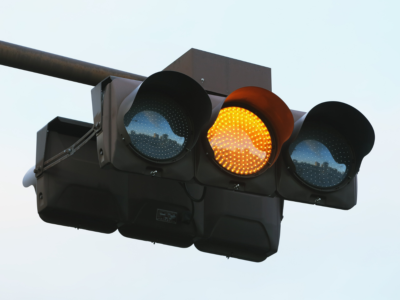
A yellow traffic light does not mean that it’s time for a driver to speed up! It warns drivers that the signal is changing and that a red light is about to appear.
In a yellow light intersection accident, insurance companies, attorneys, and juries need to examine how each driver behaved in the seconds before the crash. Speed, distance from the intersection, visibility, reaction time, turning movements, distractions, and whether a driver had a reasonable opportunity to stop safely can all matter.
If you were injured, talk to the experienced Atlanta intersection accident lawyers at Grant Law Office. We can investigate the traffic signal, vehicle movements, available video, and other evidence to determine how the collision occurred and who is responsible.
What Does a Yellow Traffic Light Mean Under Georgia Law?
Georgia’s traffic light laws are found in O.C.G.A. § 40-6-21. The statute addresses how drivers must respond to green, yellow, and red traffic signals. The driver’s behavior surrounding the signal is what may ultimately determine fault.
A driver approaching a yellow light should assess whether the vehicle can come to a safe stop. A motorist who is already extremely close to the intersection when the light changes may not be able to stop safely without creating another hazard.
A driver who is far enough away to stop but accelerates aggressively can create evidence of negligent driving.
Does Running a Yellow Light Automatically Make You At Fault?
Entering an intersection while the signal is yellow does not automatically make a driver responsible for an accident.
For example, consider a driver who is traveling at a reasonable speed and is only a short distance from an intersection when the signal changes from green to yellow. Hard braking could cause the driver to lose control or expose the vehicle to a rear-end collision, so the driver proceeds cautiously through the intersection.
Determining negligence requires examining what a reasonably careful driver would have done under similar circumstances. A car accident attorney can investigate what happened in the moments leading up to the collision instead.
Investigating Yellow Light Intersection Accidents
The important question is: “What did each driver do when the light changed?” When determining responsibility for an intersection crash, a car accident lawyer will examine several factors, including:
- The speed of each vehicle
- How far the vehicle was from the intersection when the light turned yellow
- Whether the driver accelerated or attempted to brake
- Following distance
- Driver reaction time
- Road and weather conditions
- Visibility at the intersection
- Distracted driving
- Turning movements
- Whether another driver committed a failure to obey traffic signal
- Whether the driver had enough distance to stop safely
Your Lawyer Will Collect Evidence to Strengthen Your Claim
Physical and electronic evidence can help provide a clear picture of what really happened.
Traffic and Dashcam Video
Traffic cameras, nearby security cameras, and dashcams may show when the signal changed, where the vehicles were located at that moment, and whether either driver accelerated, slowed, turned, or entered after the light became red. Video can be especially valuable because some recordings may be overwritten or deleted if they are not preserved quickly.
Eyewitness Testimony
Pedestrians, passengers, nearby drivers, and people working near an intersection may have seen the collision or the events immediately preceding it. Witnesses may be able to describe the signal, vehicle speeds, braking, or other relevant conduct.
Vehicle Event Data Recorders
Some vehicles contain event data recorders capable of preserving information associated with a crash. Depending on the vehicle and circumstances, available data may help investigators evaluate factors such as vehicle speed and braking.
Skid Marks and Physical Evidence
Skid marks, debris patterns, vehicle damage, and final resting positions can help establish how a crash happened. This evidence may also help determine whether a driver attempted to stop.
Accident Reconstruction
In serious or disputed crashes, accident reconstruction specialists may analyze vehicle damage, roadway measurements, electronic data, video, photographs, and other evidence to reconstruct the sequence leading to impact.
Intersection Accidents Involving Yellow Lights
Yellow-light disputes may involve several types of crashes.
- Left-Turn Accidents. The investigation may focus on whether the turning driver yielded appropriately and whether the approaching driver was traveling at a reasonable speed.
- T-Bone Accidents. Side-impact or T-bone collisions can occur when one vehicle enters an intersection as the signal changes and another vehicle begins moving through the intersection.
- Rear-End Accidents. A driver who is distracted, speeding, or traveling too closely may not have enough room to stop when the vehicle ahead of them applies the brakes.
- Commercial Vehicle Accidents. A commercial driver approaching an intersection must account for the vehicle’s stopping capabilities, speed, traffic, and roadway conditions.
Speak With an Experienced Atlanta Intersection Accident Attorney
Grant Law Office has been representing Georgia drivers since 2000. Our firm emphasizes thorough preparation, strategic thinking, and providing each client with individualized attention.
To find out how we can help, call (404) 995-3955 for a free consultation today.
Frequently Asked Question About Yellow Light Intersection Accidents
Does running a yellow light automatically make you at fault for an accident?
No. Running a yellow light does not automatically establish fault for a collision. Liability generally depends on the conduct of everyone involved, including whether a driver accelerated to beat the light, was speeding or distracted, failed to yield, or otherwise entered the intersection unsafely.
What evidence can be used to prove fault in a yellow light accident?
Evidence may include traffic camera footage, dashcam recordings, eyewitness statements, photographs, skid marks, vehicle damage, police reports, and vehicle event data recorder information. In serious or disputed cases, an accident reconstruction expert may also analyze the evidence to determine vehicle speeds, movements, braking, and the sequence leading to impact.
When should I contact a lawyer after a yellow light accident?
Consider contacting a car accident attorney promptly if you suffered significant injuries, fault is disputed, or an insurance company claims you caused the collision. Grant Law Office can investigate traffic signal timing, video footage, witness testimony, vehicle data, and other evidence relevant to the crash. We offer free consultations: (404) 995-3955.
Contact us today for a free and comprehensive case evaluation.
We require no legal retainer or upfront fees,
and you pay nothing unless we prevail.
Phone: (404) 995-3955

Categories
- ATV Accident
- Auto Accidents
- Bicycle Accident
- Birth Injury
- Burn Injury
- Bus Accident
- Child Injury
- Construction Accidents
- Distracted Driving Accidents
- Firm News
- Hit-and-Run Accident
- Holiday Events
- Insurance Bad Faith
- Legal Updates
- Medical Malpractice
- Mesothelioma
- Motorcycle Accidents
- Nursing Home Abuse
- Pedestrian Accidents
- Personal Injury
- Premises Liability
- Product Liability
- Spinal Cord Injury
- Traumatic Brain Injury
- Truck Accidents
- Wayne Grant Education
- Workplace Injury
- Wrongful Death


